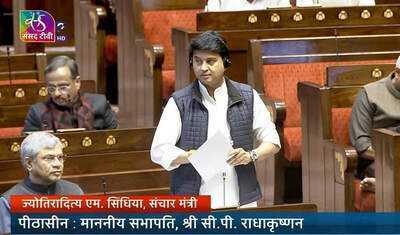
In the Parliament building in New Delhi, Union Minister for Communications and Development of the Northeast Region, Jyotiraditya Scindia, highlighted the remarkable transformations in India's digital ecosystem over the past 11 years under Prime Minister Narendra Modi's leadership. He emphasized that BharatNet is one of the world's most ambitious connectivity initiatives aimed at providing affordable and fast internet access to every citizen.
Unprecedented Growth in Mobile, Internet, and Broadband
The minister informed the house that in 2014, there were 930 million mobile users in the country, which has now surged to 1.2 billion, with mobile penetration rising from 75% to 92%. There has also been a revolutionary change in internet connectivity, with the number of internet users increasing from 250 million in 2014 to over 1 billion today, achieving a penetration rate of approximately 71.8%. Similarly, broadband users have grown from 60 million to over 100 million, with average broadband speeds reaching around 66 Mbps. Scindia described this as a digital revolution, stating that connectivity is no longer an urban privilege but a citizen's right reaching rural India.
BharatNet: A Historic Initiative for Rural Connectivity
Scindia explained that BharatNet, the primary scheme for rural broadband connectivity, is laying optical fiber cables to connect 256,000 gram panchayats across the country. With an investment of approximately ₹42,000 crore under BharatNet I and II, 214,000 gram panchayats are now service-ready. The amended BharatNet program, costing around $16.9 billion, has become the world's largest rural connectivity initiative, aiming to ensure uninterrupted internet access to the last mile by connecting remaining areas.
Advancements in Network Architecture
He also informed the house that the network architecture is being upgraded from line topology to a ring topology model. This change will ensure that if connectivity is disrupted in one direction, services will continue uninterrupted from another direction, significantly enhancing network reliability and uptime.
Need for Acceleration in Tamil Nadu under National Broadband Mission
Regarding Tamil Nadu, Scindia mentioned that the state opted to implement BharatNet through a special purpose vehicle (SPV). Out of the state's 12,525 gram panchayats, 10,886 have been connected. The remaining gram panchayats and 4,767 non-gram panchayat villages will be connected under the revised BharatNet program.
Challenges in Implementation
However, the minister pointed out challenges such as delays in Right of Way (RoW) approvals under the National Broadband Mission. He noted that the average processing time for RoW applications has decreased from 455 days to just 30.4 days, setting a global record. Out of 36 states and union territories, 33 have implemented the RoW portal, while Tamil Nadu is among the three states where it has not yet been implemented.
Comparison with Kerala's Performance
In contrast, the minister praised Kerala's excellent performance under the revised BharatNet program, with nearly 100% of its 978 gram panchayats service-ready. Over 547 gram panchayats have achieved over 98% availability. According to Six Sigma standards, around 80 to 90% of Kerala's gram panchayats meet high reliability standards, reflecting effective implementation and operational efficiency.
Call for Collaboration
Emphasizing the need for collaboration, Scindia stated that while the central government is committed to full financial support, monitoring, and guidance, active cooperation from state governments is essential for ground-level implementation. He urged all states, including Tamil Nadu and West Bengal, to collaborate creatively to ensure that citizens do not miss out on the benefits of digital connectivity due to administrative delays.
Conclusion: Digital Connectivity as a Foundation for Progress
In conclusion, the minister reiterated that digital connectivity is the cornerstone of inclusive development, economic empowerment, and national progress. Under Prime Minister Narendra Modi's leadership, BharatNet and related initiatives are ensuring that India's digital revolution reaches every village, institution, and citizen.
Contact to : xlf550402@gmail.com
Copyright © boyuanhulian 2020 - 2023. All Right Reserved.