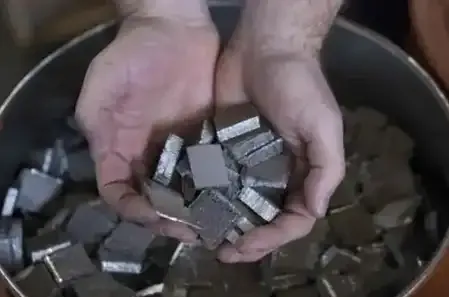
New Delhi, November 11 (IANS). The government has banned the export of waste and scrap of primary cells, primary batteries and electric accumulators with immediate effect. This also includes the black mass of the lithium-ion battery.
The Directorate General of Foreign Trade (DGFT), under the Commerce Ministry, said in a notification that it has changed the export policy of the concerned product.
According to the notification, “The export policy of waste and scrap of primary cells, primary batteries and electric accumulators and used primary cells, primary batteries and electric accumulators, unsorted and not containing lead, cadmium or mercury (lithium-ion battery black mass) under ITC (HS) code 85491400, is changed from 'Free' to 'Restricted' with immediate effect, until further orders.”
It said that this amendment has been made under the Foreign Trade (Development and Regulation) Act, 1992. Interim provisions under Para 1.05 of the Foreign Trade Policy 2023 will apply to this notification.
The government aims to strengthen domestic battery recycling capacity and ensure the supply of critical minerals.
Last week, the Union Cabinet chaired by Prime Minister Narendra Modi had approved a capital expenditure assistance scheme of Rs 2,814 crore to promote processing of critical minerals. This amount will be spent over a period of five years.
The 'Capital Expenditure Support Scheme for Promotion of Critical Mineral Processing' aims to develop domestic processing capacities in India, promote value addition within the country, reduce import dependence and develop the entire value chain.
This scheme will be applicable from the financial year 2026-27 to 2030-31. Under this, 30 percent capital subsidy will be given on eligible investment for setting up four important mineral processing plants. These include two lithium processing plants (minimum capacity of 30 thousand tonnes each) and two nickel processing plants (minimum capacity of 50 thousand tonnes each).
According to an official statement, the maximum capital assistance has been capped at Rs 500 crore for each lithium beneficiary and Rs 900 crore for each nickel beneficiary.
Currently, India is largely dependent on imports of refined intermediate products and high purity materials due to the nascent stage of domestic refining and processing infrastructure for critical minerals, including lithium, nickel and cobalt.
–IANS
abs
Contact to : xlf550402@gmail.com
Copyright © boyuanhulian 2020 - 2023. All Right Reserved.