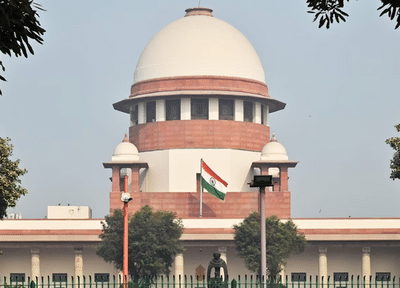
New Delhi, April 7 (IANS) The Supreme Court on Tuesday said it will hear, on April 28, a batch of pleas challenging the reduction in the qualifying cut-off percentile for the NEET-PG 2025–26 examination.
During a brief hearing, senior advocate Gopal Sankarnarayanan, appearing for the petitioners, submitted that a sufficient number of candidates had already qualified the NEET-PG examination to fill all available postgraduate seats, and that a reduction in the cut-off was unwarranted.
He argued that vacant seats persisted not due to a lack of eligible candidates, but because many qualified aspirants were unable to take admission owing to high fees.
On the other hand, senior advocate D.S. Naidu, appearing for a candidate supporting the cut-off reduction, backed the Centre’s stand and contended that lowering the percentile would not dilute academic standards, as all candidates are required to clear the MBBS qualification examination.
However, the bench of Justices P.S. Narasimha and Alok Aradhe did not go into the merits of the controversy and posted the matter for detailed hearing on April 28.
The issue stems from a public interest litigation (PIL) challenging the decision to drastically reduce the qualifying cut-off percentiles for NEET-PG 2025–26.
Earlier, the Justice Narasimha-led Bench had issued notice to the Union government, the National Board of Examinations in Medical Sciences (NBEMS), the National Medical Commission (NMC), and the Medical Counselling Committee (MCC).
The plea, filed by advocate Satyam Singh Rajput, contended that the decision to lower qualifying standards to abnormally low, zero, or even negative percentiles after declaration of results and completion of two rounds of counselling is arbitrary and unconstitutional, violating Articles 14 and 21 of the Constitution.
It cautioned that allowing candidates with such scores to enter postgraduate medical training could compromise patient safety, public health, and the integrity of medical education.
Describing the move as "unprecedented and extreme", the petition argued that NEET-PG, meant to act as a national screening mechanism, had been reduced to "an instrument certifying failure as eligibility" and further contended that the "rules of the game" cannot be altered after the selection process has commenced.
Defending the decision, the Union Ministry of Health and Family Welfare told the Supreme Court that the cut-off reduction was taken after detailed deliberations by expert bodies in view of a large number of vacant postgraduate seats and to ensure optimal utilisation of healthcare infrastructure.
In an affidavit, the Directorate General of Health Services (DGHS) said the challenge was misconceived as it pertained to an academic and policy decision taken within the statutory framework of the National Medical Commission Act, 2019.
Placing data on record, the Centre said that for the academic session 2025–26, around 70,000 seats were available, including 31,742 under the All-India Quota (AIQ), of which 9,621 remained vacant after the second round of counselling.
It added that nearly 20,000 postgraduate seats were likely to remain unfilled nationwide, prompting a review of the cut-off.
According to the Union government, the decision rendered over one lakh additional candidates eligible for the third round of counselling, without altering inter se merit or compromising standards.
It also highlighted that similar reductions had been undertaken in previous years, including lowering the qualifying percentile to zero across categories in 2023.
Arguing that courts should refrain from interfering in academic and policy matters unless decisions are shown to be arbitrary or unconstitutional, the Centre urged dismissal of the petition as devoid of merit.
Separately, the NBEMS clarified that it had no role in the decision to reduce the qualifying percentile, stating that its mandate is limited to conducting the examination and publishing results as per directions of the competent authorities, including the DGHS, the Union Health Ministry, and the NMC.
It informed the apex court that the revised cut-off, notified on January 13 following government directions, made 95,913 additional candidates eligible for counselling.
The NBEMS further said that any interference by the top court would affect these candidates, who are not parties to the proceedings, and referred to a Delhi High Court decision in Sanchit Seth vs NBEMS & Ors, which upheld the cut-off reduction and found concerns regarding patient safety and dilution of merit to be unfounded.
--IANS
pds/vd
Contact to : xlf550402@gmail.com
Copyright © boyuanhulian 2020 - 2023. All Right Reserved.