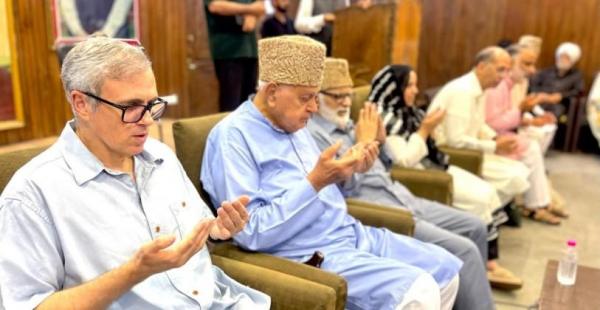
As the administration imposed restrictions in several parts of Srinagar to prevent people from assembling at the “martyrs’ graveyard” in the Naqshband Sahib area, Jammu and Kashmir Chief Minister Omar Abdullah and his arch political rival, Mehbooba Mufti, jointly opposed the authorities’ action in the Union Territory.
The lieutenant governor’s administration on Monday imposed restrictions in several parts of Srinagar to prevent people from assembling at the martyrs’ graveyard.
While the area within a one-kilometre radius of the graveyard had been sealed off since Sunday, barricades were erected in the old city and parts of the civil lines area as a precautionary measure.
Police and paramilitary forces were deployed in strength to meet any eventuality and maintain law and order.
Reacting to the restrictions imposed in parts of Srinagar, Chief Minister Omar Abdullah termed the denial of access to political leaders at the “martyrs’ graveyard” as “unfortunate” and asserted that the 1931 movement was a struggle against oppression and British paramountcy, not a religious conflict.
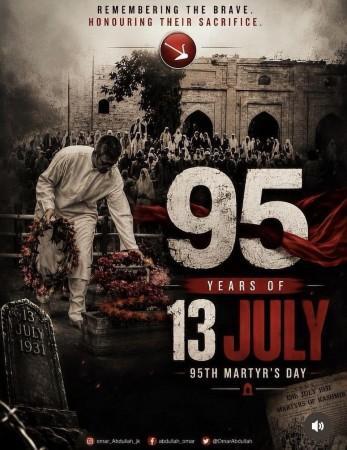
“I don’t think more than 150 people would have gone there to pay tributes, yet they treated it as a threat. This itself contradicts the repeated claims that everything is normal,” Abdullah told reporters at the National Conference headquarters, where he paid floral tributes to the July 13 martyrs.
The chief minister said the authorities should have understood the historical context of the day before imposing restrictions.
He said those who decided to seal the area should first have read the history of Jammu and Kashmir. “It is unfortunate that those who fought against oppression and to protect the dignity of Jammu and Kashmir are today being denied tributes,” he said.
Omar Abdullah also rejected attempts to portray the 1931 events along religious lines.
“This was not a religious fight. It was a struggle against oppression, for democracy and against British paramountcy. Today, attempts are being made to present it as something else,” he said.
The Chief Minister further remarked that the restrictions were imposed despite no major public gathering being planned. He also drew a comparison with previous years, saying such curbs were not enforced even during the Amarnath Yatra in the past.
“We are repeatedly told everything is normal, but the ground reality says otherwise. Earlier, such restrictions were never imposed during the Yatra. Today they are doing it,” he said.
BJP trying to give communal colour to 1931 ‘martyrs’: Mehbooba
Meanwhile, PDP chief and former Jammu and Kashmir Chief Minister Mehbooba Mufti accused the BJP of attempting to divide the region on communal lines by politicising the legacy of Kashmir’s 1931 martyrs. She also alleged that she had been placed under house arrest to prevent her from paying tributes at the martyrs’ graveyard.
“The BJP has made the sacrifice of Kashmiris a question of Hindu-Muslim, Dogra-Kashmiri and Jammu-Kashmir,” Mehbooba Mufti told reporters.
The PDP chief said the 22 Kashmiris killed outside the Central Jail on July 13, 1931, “awakened our nation” and “laid the foundation for the public sentiment we see today”.
She drew parallels with India’s freedom struggle, invoking the names of Bhagat Singh, Sukhdev, Rajguru and Ashfaqullah Khan, and asserted that her party respects all martyrs equally.
“BJP cannot control the minds of the people of Jammu and Kashmir,” she said.
Mehbooba Mufti also claimed that she was prevented from visiting the martyrs’ graveyard.
Authorities had earlier sealed roads leading to the graveyard and deployed police and CRPF personnel across the old city. The day, officially observed as a public holiday in Jammu and Kashmir until the abrogation of Article 370 in 2019, continues to be commemorated by regional political parties.
J&K divided over July 13 event
There is a clear regional divide between the Jammu and Kashmir regions over the observance of “Martyrs’ Day” on July 13.
While political parties in Kashmir observe it as “Martyrs’ Day”, several organisations in Jammu observe it as “Black Day”.
Since 1948, July 13 had been commemorated as “Martyrs’ Day” in Jammu and Kashmir. After becoming the first Prime Minister of the erstwhile state in October 1947, Sheikh Mohammad Abdullah declared the day an official holiday to remember those who had rebelled against the then “autocratic” Dogra ruler and sacrificed their lives.
Twenty-two people were killed on July 13, 1931, during a protest against the then Dogra ruler of the erstwhile princely state of Jammu and Kashmir, Maharaja Hari Singh. Until 2020, the day was an official public holiday and was observed across Jammu and Kashmir. The Chief Minister, ministers and the Director General of Police (DGP), Jammu and Kashmir Police, used to offer floral tributes at the graves of those who had died in 1931. Since the abrogation of Articles 370 and 35A in 2019, no official function has been held on this day.
During the past few years, the observance of July 13 as “Martyrs’ Day” has created a regional divide, with many organisations in Jammu observing it as “Black Day” to recall what they describe as the “first attack” on the religious minorities of Jammu and Kashmir.
Not only displaced Kashmiri Pandits from the Valley but also several Jammu-based social and political organisations have held protests at various places to oppose the government’s earlier decision to declare the day an official holiday, alleging that it glorified what they describe as the first communal attack on religious minorities.
Following the abrogation of Article 370 and the bifurcation of the erstwhile state into two Union Territories, the administration, on December 27, 2019, dropped July 13 and December 5 from the list of public holidays for 2020. December 5 is the birth anniversary of National Conference founder Sheikh Mohammad Abdullah.
The administration, however, declared October 26 a gazetted holiday. On this day in 1947, Maharaja Hari Singh signed the Instrument of Accession with the Indian Union.
The decision to drop both holidays triggered a controversy, though the issue gradually subsided. The National Conference demanded that the decision be reviewed, arguing that Sheikh Abdullah’s role in the democratic awakening of the people of Jammu and Kashmir could not be undermined and had been acknowledged worldwide.
Contact to : xlf550402@gmail.com
Copyright © boyuanhulian 2020 - 2023. All Right Reserved.