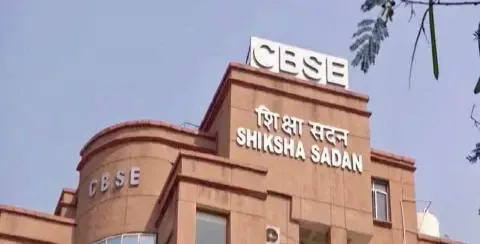
New Delhi: Class-VI students of Central Board of Secondary Education (CBSE) schools will not have to sit for three language papers when they appear for their Class-X board examinations.
The Supreme Court, on Monday, directed CBSE to grant one-time exemption from its three-language policy to students currently studying in Class 6, observing that the decision is taken to extend the same “comfort” as available to students of Class 7, 8, and 9.
The interim order was passed by the bench of Chief Justice of India (CJI) Surya Kant, Justice Joymalya Bagchi and Justice V Mohana, while hearing a bunch of petitions challenging the rollout of the three-language policy, as reported by Hindustan Times.
“We direct the students of Class 6 may be granted the same exemption as granted to Class 7 students,” the Court said while posting the hearing on the main issue concerning the three-language policy and treating English as a foreign language after six weeks.
The CBSE, represented by Solicitor General Tushar Mehta along with additional solicitor general (ASG) Aishwarya Bhati informed the bench that pursuant to the court’s suggestion of exempting the present Class 6 students, the matter was considered and CBSE has decided to implement it for Class 6 students starting this year.
Of the 28,000-odd CBSE schools in the country, almost 99% have adopted the policy and have the requisite books and teachers, Mehta said. Only 1.2% of the schools are facing difficulty implementing the rollout, he said.
Class 6 was intended to be the starting point for the relevant cohort under the National Education Policy (NEP) 2020 and National Curriculum Framework for School Education (NCF-SE) 2023, he further said.
Exempting the present batch would mean that students enter Class 7 and 8 without the learning exposure and continuity contemplated under the revised framework, Mehta submitted.
The bench, however, said that: “Let students of Class 6 have the same comfort as Class 7 students. What we are saying is that so many months have passed since the academic session began in April. Have it implemented from April 2027. By then, the books and requisite teachers will also be available.”
“Please consider that we are not putting any interdict on the CBSE scheme. We asked for an exemption this year so that students can come to terms with the change. It was only a question of a soft launch so that they could be given the same privilege as Class 7 students,” the Court observed.
The petitioners represented by senior advocates Gopal Sankaranarayanan and Anand Grover among others said that the issue cannot be prolonged due to anxiety among students. The Court even proposed to have a committee of officers who are experts to reach out to the schools which are facing difficulties in implementing the policy.
The petitioners argued that the parents of these children have waited enough and the issue concerns the future of nearly 3,00,000 students studying in CBSE schools. Sankaranarayan said that while these students are already burdened psychologically and mentally, the CBSE should consider reducing the burden of introducing anything in the middle of the academic calendar.
“We made the suggestion due to the impact it had on children so that the question of logistical difficulty does not become a pressing concern,” the Court said.
The Board had earlier told the court that Class 6 textbooks for the third language in all 22 scheduled Indian languages were already available on the NCERT website, covering the choices of over 98% of schools. For the remaining languages, SCERT textbooks and resources would be used.
On teacher availability, the CBSE said data from 20,777 schools showed that 19,386, or about 93.3%, already had teachers for at least two distinct indigenous languages. Of these, 3,523 schools had teachers for three or more such languages.
Contact to : xlf550402@gmail.com
Copyright © boyuanhulian 2020 - 2023. All Right Reserved.