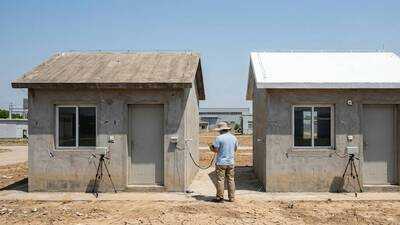
Of all the parts of a building, roofs receive the most intense sunlight, and during a hot summer, a large portion of that heat is transferred directly to the rooms below. Cooling has become such a significant portion of urban electricity demand because air conditioners have to work harder to push it back out. For years, engineers have looked for roofs that can shed heat on their own, and one approach has drawn growing interest in China. It is known as passive radiative cooling , and it functions by both reflecting sunlight and releasing heat into space through the atmosphere. Hefei, a city in eastern China, has conducted a field test to determine the actual impact it can have.
Wenshuo Zhang, Dongsheng Jiao, Bin Zhao and Gang Pei, in Applied Energy (2024), created two concrete experiment rooms side by side. One was coated with a passive radiative-cooling metamaterial on the roof, and the other had a normal concrete roof as the control. The in July, the coated room's air temperature peaked 5.5°C lower than the reference room's and averaged 1.8°C lower when the indoor temperature control system was off.
How the test was arranged
The design was intentionally simple. The two rooms were similar in every way: they had the same concrete construction, were in the same location, and experienced the same weather, but there was one difference on the roof. This alteration makes the comparison valid because any difference in temperature can be attributed to the coating, not shade, wind or the quality of the structure.
The researchers ran the experiment over an extended period and tested it in two configurations. In the first, the rooms were neither air-conditioned nor heated, so they simply showed how the buildings behaved on their own. In the second, an indoor temperature control system was switched on so the team could measure the energy needed to keep each room comfortable.
What the figures revealed
In summer, the coated room required 29.1 per cent less cooling energy per day when the temperature control system was operating. That is a substantial saving for a change made only to the roof, which suggests the technology has practical potential. Another field investigation in Hong Kong points the same way. Researchers from tested a radiative cooling layer over the concrete roof of an in-service office building. The coating reduced the outside roof surface temperature by up to 21.1°C. Air conditioning set to the same levels saw interior air temperatures drop 2.8 degrees Celsius and electricity usage decrease by 20 per cent. Their simulations across Chinese cities found an average cooling energy savings of 49.42 per cent annually. 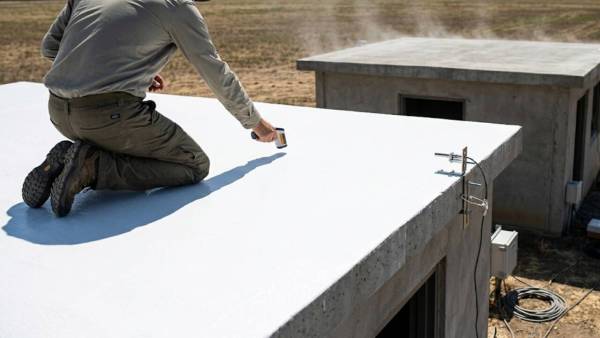
The winter catch
A roof that sheds heat all year doesn't know when you'd like to keep it. In the Hefei test, the coated room used 4.1 per cent more heating energy per day in winter, a phenomenon the authors refer to as overcooling. Their construction simulations indicated the same division on a broader scale. Radiative cooling roofs lowered overall energy loads in tropical, subtropical and most warm temperate regions but increased them in cooler locations such as most medium temperate zones, cold temperate zones and plateau climates.
Researchers are also working on ways to address the drawback. Aaswath Raman and colleagues showed how a surface can cool below the surrounding air under direct sunlight in a 2014 Nature study, and later work has sought to make the effect tunable. One example is a on combining daytime radiative cooling and solar heating for year-round energy savings in buildings.
The Hefei results provide a clear conclusion for now. In this test, the passive roof coating reduced indoor peaks by more than five degrees and cut cooling energy by almost a third. Buildings in warmer regions are likely to benefit most, and future designs may aim to switch the effect off in cold weather.
Contact to : xlf550402@gmail.com
Copyright © boyuanhulian 2020 - 2023. All Right Reserved.