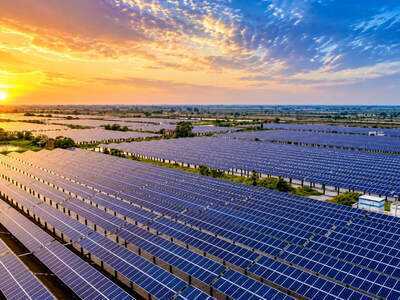
New Delhi: India's agricultural sector could generate demand for an additional 116 GW of solar modules, creating a major market opportunity for domestic manufacturers as the government expands efforts to solarise irrigation pumps and reduce the sector's dependence on conventional electricity and diesel, according to a report by the (ISMA).
The report, titled Powering the Farms, Building the Factory (PM-KUSUM: Solarising Agriculture and Strengthening Domestic Manufacturing), estimates that could account for 100 GW of additional solar module demand, while diesel-powered pumps could generate another 16 GW, excluding those located in groundwater-stressed areas.
With nearly 2.3 crore irrigation pumps across the country, could emerge as a significant source of long-term demand for India's solar manufacturing industry, linking the country's clean energy transition with its push to expand domestic manufacturing capacity.
Launched at the Bharat RE Summit on November 2, the report identifies the Pradhan Mantri Kisan Urja Suraksha evam Utthaan Mahabhiyan (PM-KUSUM) as an important driver of this opportunity, highlighting the potential of the programme to create a sustained market for domestically manufactured solar modules and cells.
PM-KUSUM added a record 7.6 GW of solar capacity in FY26, while more than 28 lakh irrigation pumps had been solarised by July 2026, the report said.
The Domestic Content Requirement (DCR) under Components B and C of the scheme has also helped channel demand towards Indian manufacturers. By October 2026, installations under these two components had reached 13.8 GW, meeting nearly two-thirds of the 20.8 GW of domestic manufacturing demand originally projected, according to ISMA.
The report argues that the scale of India's agricultural electricity consumption provides an additional economic rationale for accelerating pump and feeder solarisation. Agriculture accounts for 17.88 per cent of the country's total electricity consumption, while tariff subsidies billed by distribution companies (DISCOMs) doubled from Rs 1.21 lakh crore in FY20 to Rs 2.41 lakh crore in FY25.
Solarising agricultural pumps and feeders could help improve the availability of electricity for farmers while supporting more sustainable energy consumption and reducing the financial burden associated with subsidised agricultural power, the report said.
Commenting on the findings, ISMA Secretary General Amit Manohar said: "PM-KUSUM has emerged as an important link between India's agricultural development and domestic solar manufacturing ambitions. The estimated 116 GW of additional module demand from the agricultural sector presents a significant opportunity for Indian manufacturers. Sustaining this momentum will require continued policy support, adherence to domestic content requirements and a predictable project pipeline to encourage investments, strengthen the domestic supply chain and expand manufacturing capabilities."
The report calls for retaining DCR provisions under PM-KUSUM to ensure that the expansion of agricultural solar capacity translates into demand for domestically manufactured equipment.
It also recommends clearly defined state-wise solarisation targets and multi-year tender pipelines to provide manufacturers with greater demand visibility and encourage investment in additional production capacity.
On the implementation side, ISMA has called for stronger mechanisms to facilitate land access, statutory clearances and grid connectivity, which can influence the pace of project execution across states.
The report also flags the need to deepen domestic manufacturing beyond solar modules and cells, with greater investment in upstream capabilities such as silicon wafers and ingots to reduce supply-chain dependencies and strengthen India's manufacturing ecosystem.
The findings point to agriculture as a potential additional demand centre for India's expanding solar manufacturing industry. However, translating the estimated 116 GW opportunity into actual orders will depend on the pace of pump solarisation, state-level implementation, continued domestic-content requirements and the development of a predictable project pipeline.
For domestic manufacturers, the scale of the opportunity will therefore depend not just on the installation targets under PM-KUSUM, but also on the government's ability to sustain procurement and implementation over multiple years.
Contact to : xlf550402@gmail.com
Copyright © boyuanhulian 2020 - 2023. All Right Reserved.