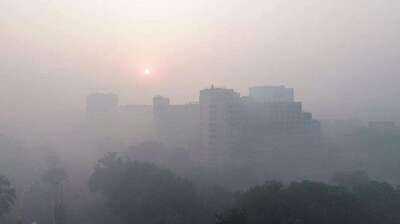
Chandigarh: Haryana continued to choke under high pollution levels on Tuesday, with Panchgaon emerging as the most polluted city in the country, recording an Air Quality Index (AQI) of 380 in the Central Pollution Control Board's (CPCB) 4 pm bulletin. The reading, based on the average of the preceding 24 hours, was 81 points higher than Delhi's AQI of 299, which remained in the 'poor' category.
The post- Diwali pollution surge, triggered in part by widespread bursting of firecrackers, has left the National Capital Region (NCR) and adjoining Haryana districts grappling with a thick blanket of polluted air. The sharp deterioration following Sunday's Diwali celebrations was reflected in elevated PM2.5 levels across the region.
Haryana's pollution hotspots were not confined to the NCR. Of the state's monitoring locations, Panchgaon recorded the worst air quality at 380, followed by Ballabgarh at 340, Kaithal at 336, Gurgaon at 323 and Sirsa at 322. All five were in the 'very poor' category. Hisar (316) and Kurukshetra (315) were also in the same category.
Panchgaon's reading was not only the highest in Haryana but also the highest among the 287 cities featuring in Tuesday's national bulletin. No city in the bulletin had entered the 'severe' category, which begins at 401. Delhi's 299, meanwhile, was just short of the 'very poor' threshold of 301.
Fine particulate matter (PM2.5) emerged as the dominant pollutant at all five worst-affected Haryana locations, pointing to the continuing concentration of fine particles in the air. The CPCB bulletin covers 23 Haryana monitoring locations, while readings for cities with multiple stations represent averages rather than individual station peaks.
The deterioration comes despite the Commission for Air Quality Management (CAQM) having invoked successive stages of the Graded Response Action Plan (GRAP). Stage I restrictions were introduced on Oct 21, Stage II on Nov 2 as air quality entered the very poor range, and Stage III restrictions for severe pollution were invoked across the NCR on Nov 6.
The measures include curbs on polluting activities, construction and dust-generating operations, besides tighter enforcement against polluting vehicles and industrial sources. The state has also stepped up measures against road and construction dust, including directions for effective deployment of water sprinklers and dust-suppression arrangements. To prevent farm fires, Haryana has planned drone-based surveillance, late-evening patrols and a dedicated Parali Protection Force, backed by village-level nodal officers and field monitoring.
The latest available cumulative Active Fire Location (AFL) figures, up to November 9, put Haryana's farm fires at 192 this season. This was lower than 333 during the corresponding period last year and 4,753 in 2021, indicating a substantial decline in reported incidents, though enforcement remains crucial.
The continuing pollution spike underlines that stubble-burning control alone cannot address the crisis. Firecracker emissions, vehicular exhaust, industrial pollution, road dust and construction activity are adding to the winter pollution burden across Haryana and the NCR.
Correction to the preliminary table above: Ballabgarh's AQI of 340 places it second, ahead of Kaithal. The correct graphic is:
GRAPHIC | Haryana's five worst-polluted cities
CPCB, November 10, 4 pm | 24-hour average
Panchgaon
380
Ballabgarh
340
Kaithal
336
Gurugram
323
Sirsa
322
Contact to : xlf550402@gmail.com
Copyright © boyuanhulian 2020 - 2023. All Right Reserved.