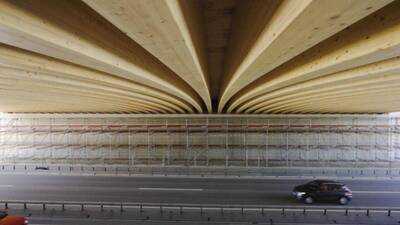
Switzerland has built a wildlife crossing over a motorway between Zurich and Bern using one of the world’s first post-tensioned timber bridges. Located at Koppigen, the structure spans both the motorway and the Koppigen cantonal highway, reconnecting two natural areas that were previously separated by roads. The bridge is designed to let wildlife cross safely while reducing habitat fragmentation and the risk of collisions between animals and vehicles.
According to Bouygues Construction, the project was commissioned by Switzerland’s Federal Roads Office (ASTRA). It has a timber superstructure with two spans, including a 37-metre main span, supporting a concrete slab and backfill.
How does the Koppigen wildlife crossing help animals cross the motorway
The Koppigen wildlife crossing spans the motorway linking Zurich and Bern and the Koppigen cantonal highway. It was commissioned by the Federal Roads Office (ASTRA) to reconnect two natural areas separated by roads. The structure allows wildlife to cross safely and helps reduce habitat fragmentation. It is also intended to limit collisions between animals and vehicles, which can harm biodiversity and road safety.
Covered with approximately one metre of earth and vegetation, the bridge creates an ecological corridor across the transport routes. Its construction brings together a timber superstructure and a concrete slab, with backfill and natural covering above.
What makes the 37-metre timber bridge an engineering achievement
The bridge’s timber superstructure consists of two spans, including a main span measuring 37 metres. These support a concrete slab, backfill and a covering of earth and vegetation. The complete structure carries heavy loads because of the materials placed above the timber. This made the use of post-tensioning technology necessary, although the method had rarely been used in timber structures before.
Post-tensioning was originally developed for concrete, but the VSL International team adapted it for wood. The aim was to distribute high forces across the timber without causing damage. A large steel plate fitted with numerous small anchorages formed the basis of the customised system.
How did researchers help develop the post-tensioned timber bridge
The engineering work drew on several years of research and testing carried out in Switzerland. The studies involved the Higher Technical School of Wood in Biel and ETH Zurich. They examined how post-tensioning could be applied to timber and assessed its structural benefits. The research confirmed that the method can improve wood’s load-bearing capacity and reduce deformation.
It can make maintenance easier. These findings supported the development of the Koppigen bridge, where timber had to carry the loads created by the concrete slab, backfill, soil, and vegetation. The project applied a technique more commonly associated with concrete to a bio-based material with low carbon emissions.
What role does the Koppigen bridge play in restoring wildlife connectivity
The Koppigen crossing was built to address the barrier created by the motorway and cantonal highway between two natural areas. By providing a route above the roads, it is intended to restore ecological connectivity and allow animals to move between habitats. The layer of earth and vegetation helps the bridge form a continuous corridor rather than a bare road overpass.
The project also aims to reduce collisions between wildlife and vehicles, supporting biodiversity and road safety. Bouygues Construction contributed to the work through its subsidiary, VSL International. The company adapted post-tensioning technology for use with timber, developing a customised anchoring solution for the structure.
Contact to : xlf550402@gmail.com
Copyright © boyuanhulian 2020 - 2023. All Right Reserved.