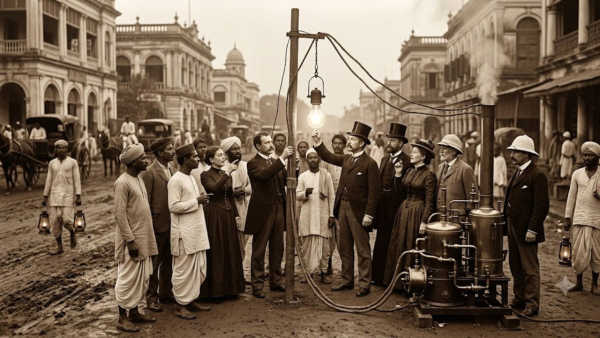
Bengaluru introduced electric street lighting in 1905, using electricity generated at Shivanasamudra Falls. Discover how a hydroelectric project built to power Kolar Gold Fields helped illuminate the city.
Today, Bengaluru is widely recognised as India’s Silicon City and a major information technology hub, known for its startups, multinational companies, metro rail network and modern infrastructure. However, more than a century ago, the city presented a very different picture after sunset. As darkness descended upon its streets, workers had to manually light kerosene lanterns to provide illumination. They would fill the lanterns with fuel, clean the soot from their glass covers and light them one by one. This routine continued until a remarkable technological development transformed Bengaluru’s nights.
In August 1905, the city witnessed the introduction of electric street lighting, marking a significant milestone in its journey towards modernisation. Interestingly, the electricity that illuminated Bengaluru was generated from the waters of Shivanasamudra Falls, located hundreds of kilometres away. The story of how a waterfall helped light up Bengaluru remains a fascinating chapter in the history of Karnataka.
How The Kolar Gold Fields Led To Bengaluru’s Electrification?
The story of Bengaluru’s electric lighting began at the Kolar Gold Fields (KGF), where gold mining operations were flourishing in the early 20th century.
Miners working at KGF had to descend deep underground to extract gold. However, inadequate lighting made mining operations, particularly during night shifts, difficult. To address this challenge, engineers explored the possibility of generating electricity through hydropower.
They identified the waters of Shivanasamudra Falls on the Cauvery River as a suitable source of energy. A hydroelectric power station was subsequently established at Shivanasamudra to generate electricity for the KGF gold mines, located approximately 150 kilometres away.
The project marked a major technological achievement for the region. By harnessing the power of flowing water, engineers were able to generate electricity and transmit it over a considerable distance to support mining operations.
Shivanasamudra Hydroelectric Power Station
The hydroelectric project at Shivanasamudra became an important milestone in the history of electricity generation in India. It was developed primarily to meet the power requirements of the Kolar Gold Fields, where electricity was essential for mining activities.
As the project progressed, electricity generation increased. Historical accounts indicate that by 1905, an additional 2,000 horsepower of electricity had become available.
The availability of surplus power created an opportunity to extend electricity beyond the gold mines. Engineers began exploring whether the additional electricity could be used for other purposes, including lighting the streets of Bengaluru.
How Bengaluru Benefited From Hydroelectric Power?
The transmission line carrying electricity from Shivanasamudra to the Kolar Gold Fields passed through Bengaluru. This provided engineers with an opportunity to connect the city to the growing electricity network.
The then Chief Engineer, William McHutchin, proposed using the surplus electricity generated at Shivanasamudra to illuminate Bengaluru’s streets.
The proposal was presented to the Maharaja of Mysore, Nalwadi Krishnaraja Wadiyar. Recognising the potential of electric lighting to improve the city’s infrastructure, the Maharaja approved the plan.
Following the approval, work began to establish the necessary transmission and distribution infrastructure. Within approximately nine months, a transmission line around 57 kilometres long was constructed to carry electricity from Kanakanahalli, near present-day Kanakapura, towards Bengaluru.
The project laid the foundation for the introduction of electric street lighting in the city.
August 1905: Bengaluru’s Streets Shine With Electric Light
A historic moment arrived in August 1905, when Bengaluru witnessed the introduction of electric street lighting.
At around 7 pm, people near K.R. Market were going about their usual activities when an important event took place. Sir John Hewitt, a member of the Viceroy’s Council, switched on the electric streetlights.
As electricity flowed through the network, the streets were illuminated in a way that had never been experienced before. The transition from manually lit kerosene lanterns to electric streetlights marked a major change in the city’s public infrastructure.
Bengaluru is widely credited with becoming the first city in Asia to introduce electric street lighting. The achievement placed the city among the early adopters of modern electrical technology and represented a significant step in its urban development.
861 Streetlights And Electricity Connections For 1,639 Homes
The introduction of electric street lighting was only the beginning of Bengaluru’s electrification journey. Over time, the electricity network expanded to cover government offices, commercial establishments and private residences.
Initially, electricity connections were largely limited to wealthy residents and a select group of private households. However, as the network developed, more homes began gaining access to electric power.
Historical reports indicate that by June 1906, Bengaluru had 861 streetlights and electricity connections for 1,639 homes.
The electrification project reportedly cost around ₹6 lakh at the time, while its annual maintenance expenses were estimated at ₹50,000.
To encourage wider adoption, the government also introduced a scheme under which residents could use a light bulb for a monthly fee of ₹1. The initiative reportedly attracted considerable interest, making electric lighting increasingly accessible to households.
How A Waterfall Changed Bengaluru’s Future?
More than a century later, Bengaluru has grown into a major technology and economic centre, with a rapidly expanding urban landscape and modern infrastructure. Yet, the introduction of electric street lighting in 1905 remains an important chapter in the city’s history.
What began as an effort to provide electricity to the Kolar Gold Fields eventually helped transform Bengaluru’s streets. The transmission network passing through the city, combined with the availability of surplus electricity, created an opportunity that changed the way Bengaluru functioned after sunset.
The energy generated from Shivanasamudra Falls played a crucial role in this transformation. By harnessing the power of the Cauvery River, engineers helped bring electric lighting to Bengaluru and contributed to the city’s early modernisation.
The story serves as a reminder that Bengaluru’s journey towards becoming a modern city began long before its rise as India’s Silicon City. In 1905, electricity generated from a distant waterfall illuminated its streets and opened a new chapter in its urban history.
Contact to : xlf550402@gmail.com
Copyright © boyuanhulian 2020 - 2023. All Right Reserved.